Thursday, March 7, 2019

Blackwork Waistcoat

I have created an English Blackwork Waistcoat.  It is Linen, embroidered with Black Silk thread, Silver Metal thread, Silver Paillettes in two sizes.  It is lined in White Silk.  The entire coat is hand sewn.  Only the Black Lace and Black Silk ribbon ties were purchased.

When I began I knew this would be a long term project.  The prep work would take about 6 months.  The actual embroidery took at least two years.  Assembly, hand sewing the coat together, another 3 months.  It has been finished about 6 months now, but I have been saving it for the King and Queens Arts and Science competition. ( march 30, 2019)

Process of making a Blackwork Waistcoat.

One.  Make a Waistcoat.
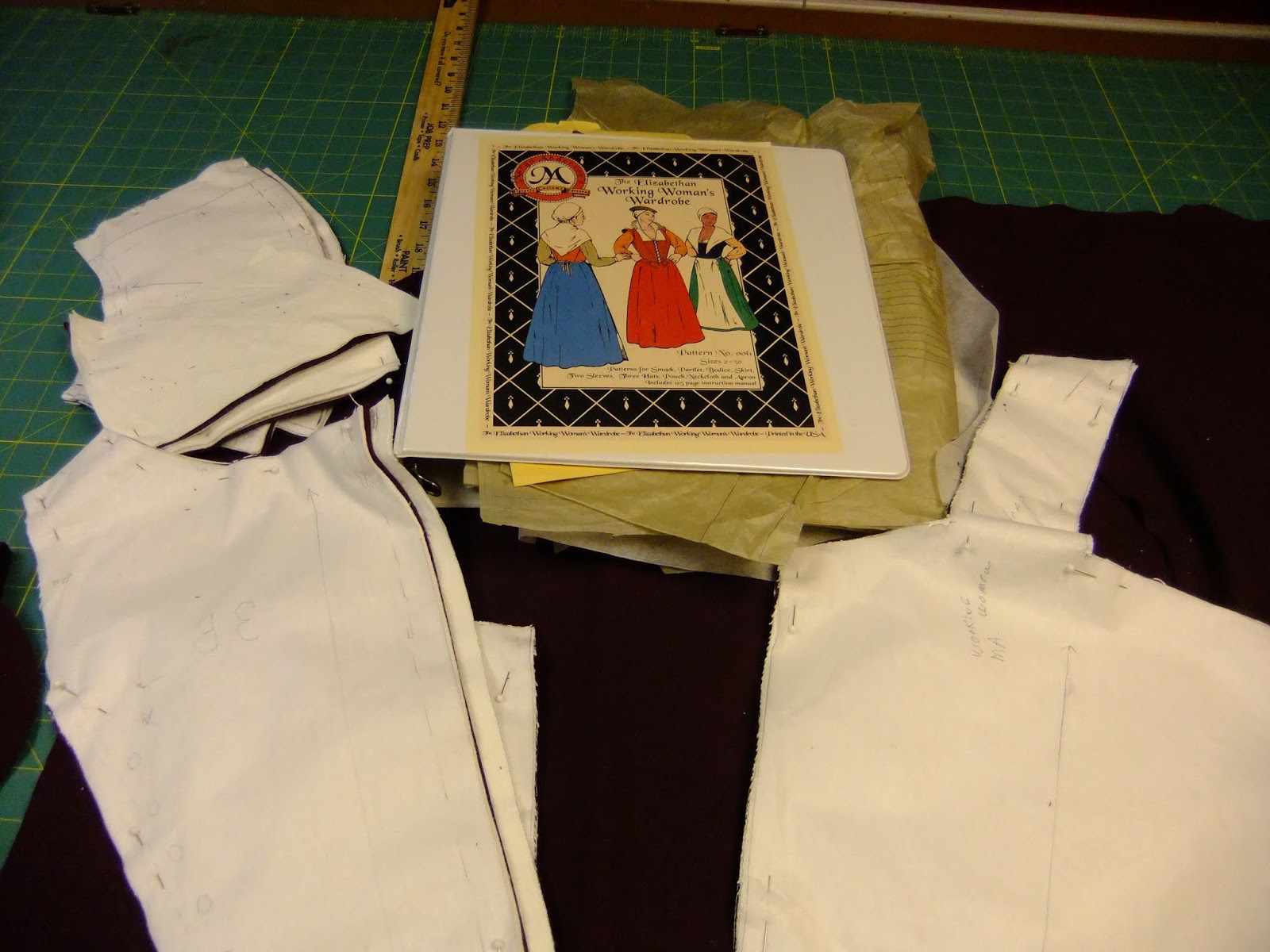
I first needed to make a waistcoat, which fit.  I used two main sources to create my pattern.  Reconstructing History pattern, and The Tudor Tailors book and chart.  My first coat was made out of  yellow linen.

I had difficulty fitting over the breast area.  Not unusual for women.  I had too much bubble in the center.  Needed to cut that down.  So a couple of reconstruction solved that problem.  The lining was also a problem.  Where the linen was will to "give" the poly lining underneath stayed too tight.  My solution for this test coat was to simple unsew the center back seam, and finish them off as.

Started the second jacket out of nice white linen.  I had learned important construction tips.  The gores are best done surface stitching on the outside.  This coat fits much better, and I have worn it often.  


The coat was too long in the back.  This is a regular problem for me.  Even when I measure and cut correctly I get ripples.  Again the Lining was tight, and the linen looser.  But that is the nature of these two different fabrics.

2  So now you have a pattern ..  What next
Research.  What Pattern.  There are several extant examples of Blackwork coats.  What did I want to do.  
English embroidery was evolving with time.  Earlier Jackets were monochrome with simpler patterns, as time past you see Polychrome jackets with more and more use of metal enhancements. So what period did I which to do.  
One inhibiting factor was, I can't draw. But in period that was not a problem.  I came across patterns by Laura Mellin.  She studied extant Coifs, and recreated patterns for them.  One was created from a small extant piece in the collection at the Bath Costume Museum in Bath England.  That this has been drawn out onto a copy able medium worked for me. In period there were pattern books, and pattern drawers at Broidery Shops.  Having my linen sent to a Broidery's shop was common.  To test out the pattern I made the coif first. 
I decided to enhance this coif by substitution silver Paillettes for the buds on the branches, and the peas in the pea cots.  This added a touch of sparkle to the piece.  Also added to the level of who would have worn such an item.  The use of silver showed wealth.  For stitches I used stem stitch for out lining the leaf, and the stems.  The pea cots were buttonhole stitch. Then I decided to shade the leaf with speckle stitch.  This added to the piece big time, and to the time required to complete it X2.

3)  Transferring the pattern
So I have a patter.  But it's in the shape of a coif.  I needed to transfer the pattern to a medium that I could then use to transfer the patterns to the coat pieces.  I took a square from the pattern, and painstakingly move it from place to place along the pattern material to create a embroidered coat in transfer material.  
Transfer material on left, transfer material with pattern on right.  


Brown Wool Fitted English Gown


Next up is a Brown Velvet trimmed English Fitted Gown.  On this gown I decided to try my hand at pad stitching.  I had purchased the Modern Maker Books to learn how to make my upper parts of gowns more authentic.

The pad stitching is done to reinforce the shoulder area of a Doublet or Gown.  Since I had never done this, Had known of it for many years, decided to up my game and give it a try.


A lot of stitching to do the pad stitching.  It's hard to see because I used the first thread I reached, which was a pale gold color, so does not show up well.  I had some cream colored wool felt in my stash, which I used for the interlining.  The brown wool was a medium weight (not heavy weight) which did not have a lot of structure of its own.  It worked well for the skirts, flowed.  But the combination worked OK together for the upper.  I also added a layer of linen canvas, which I pad stitched the wool felt too.  

I lined the gown with a cream colored silk (poly) lining, with a tone on tone fleur-de-lees embroidered into it.  
What I learned.  This does give a lot more structure to the top of the coat.  Not totally happy with the front edges of this Gown.  With the padded interlining it seems too thick.  The lining is blooming at the inside edge, and shows much more then I like.  If I was to do this again, I would shave down the edge of the interlining, so it would not be so thick.  Or I may use a wool fabric which is stiffer and not as thick.  Material choices are always important.

Pennsic wardrobe

Working on 12, yes 12 new Linen Kirtles to wear.  After going thru my stash, I had enough Linen to make these, and still have Linen left over.  For the last several years I have been buying this linen and adding to stash.


Getting the back right is the problem.  The black is too low in the back.  When I add sleeves, they pull the shoulder straps right off.  I have very narrow slopping shoulders (and I lift weights).  So finding a back style was important.  I finally settled on the one from the Tudor Tailors book.  This works.  The length in the plum one is too long, I have shortened the back pattern piece.  Now that I have the fit I want, I am off to the sewing machine.


12th Century Bliaut

This years 12th night event was to be set in 12th Century France.  I decided to make a Bliaut to wear.  I did it from my usual, this will be easy, point of view.  After doing fitted English clothes, this should be easy, it's only rectangles.  As usual I Was Wrong.
The first rule was, the material had to come from stash.  Everything but the brown silk come from it, so a Win.  Some items have been in stash for 15 + years.
I chose a very light (tropical) weight yellow wool for the gown.  This had a nice flow to it. To give more structure to the neck line I used a heavy weight silk.  This was perfect.  I used this silk for the lining of the sleeves also.  In my stash was some old trim to make the sash. The base color of the trim was blue, but the brown from the silk was in it.  This added a third color, and blended/contrasted nicely.
Fitting was a case of measure me, measure the material, back and forth.  I did not have a pattern, just a diagram as to parts.  Mostly it was rectangles. The sides I did not close, but folded the material in to pull in the waist, added lacing holes (had to reinforce them with a strip of linen inside the folded material).   I did set in sleeves, as I look terrible in square sleeve tops.  The wool was almost sheer, so I made a sleeveless linen chemise to wear under it.  I tried to add a blue silk sleeve to the chemise, but won't work, so added them to the gown.  Thus fake under tunic of blue silk.  Made the look.
Added a veil, had a silk one in my collection and jewelry.  Made a head piece to wear over the veil with the sash trim.  The sash trim was sewed onto belting material, had enough to cover both sides of belting material.  Added three heavy gold beads for weights at the end of each sash, to make it hang properly.
Was very happy with results.


English Fitted Gown Fall2018


Made this outfit in Fall of 2018.  After a successful diet, I needed new clothes.  Wanted to work out a new pattern for a Fitted English Gown.  Made a new sized Black linen Kirtle to wear under.  And a Fancy Jeweled Placard.


Sunday, August 19, 2018

French Hood


This is a few years old - 2014/15.  I had never taken a picture of me in it.  French Hood of Black Velvet.  There are two Billaments.  The front edge is Gold and Pearl,  The rear is a double strand of Pearls and Ruby Cabochons.  I have done little jewelry making, so doing these was a learning curve, but fun.  I started this hood at a Pennsic class, then like all good project set it aside for a while.  I was dusting it off for Coronation, and wore it with my new Gold and Black English.
All together.  Photo Brendan  Crane.

My Laurel's Pelican Hood.

My Laurel - Mistress Nest Verch Tangwistle, was elevated to the peerage of Pelican at the K&Q Archery Championship.  Debated on what to make.  Ended up making her an early period Viking hood out of Blue Linen.  The seams are all finished in Gold Silk embroidery. Mistress Nest colors are Blue and Gold.
I embroidered a Pelican in a laurel Wreath (to symbolize she is a Laurel and a Pelican)  It is done inm silk thread, split stitch, on linen.  This was then applicated onto the hood.  Do not have a final picture, but here are photo of the other parts 


Pictures do no show the deep blue color of the linen.
  

Friday, August 17, 2018

Black English Loose Gown - Long coat


Fitted out an English Loose gown based on a pattern draft from the Tudor Tailors book.  This is a heavy black wool, and is lined in black Satin.

The coat is edged with black velvet ribbon.  The overcast of the ribbon over the sleeve edge was tricky.  I took a lot of small tucks in the ribbon to get it to curve.
The skirt is done in large box pleats.  This is to date one of my favorite items, but alas I can only wear it in Winter.  Last Birka I paired this with a Velvet skirt with Bodice that had a forepart of the figured velvet.  Looks really nice.  Entered it into the Birka fashion show.  Didn't win, but Axel did with his outstanding men's English doublet and breeches he made.  No pictures. :)  

English Jacket


I drafted up, and constructed and English short jacket using some left over gold Linen I had.  The biggest problem I had was fitting over the bust line.  Clothing of this period does not use darts, so shaping when cutting is important.
I am not one to make something only from muslin, then discard it.  If I am going to make it, I will wear it.  I feel I am a good enough seamstress to do this.
Update:  I have taken the front seam apart and cut the bust line down, so there is not so much of a "pump" in the from.
Wearing the Jacket with bum roll.  

These shoot were taken during fitting of second Linen Jacket.  The back is too long, which is causing it to buckle.  The front is held together with safety pins, later I will install hooks and eyes.
Third Jacket.  This is a low neck Jacket. 


New Wardrobe Fall of 2014/2015


After several years wearing OK garb I worked towards making a more authentic Wardrobe.  I will concentrate on a 1500's English persona.  I will continue to refine this into a Lady from 1571.

I used as my base two pattern sources.  Ended up making, in Linen  4 Kirtles:  Blue, green, gold and red.  And two Bodices with Skirts:  Purple Bodice w/skirt,  Black Bodice w/Skirt, and 1 Tan skirt.  Also adjusted what was once a poorly made Kirtle into just a Red Skirt.  I salvaged an older Red Skirts I had made out of a stiff Cotton Broadcloth.  I use this as the underskirt for structure, also it is red (for my health, of course).  It has a modern Zipper (old Ren faire outfit) but no one sees it.  
 Added partlets and wired coifs from the Tudor Tailors. This is a blue wool Kirtle, with lots of skirt.  I wear this often when being a Merchant.  This partlet is black wool.  Made several styles of white linen partlets.  Also need lots of new Linen Chemises to wear under.
All told I made over 20 new pieces of clothing for my wardrobe.
Update:  This was several years ago.  Since then I have lost over 35 pounds.  As a result most everything is too large.  I tried taking in, but outside of deconstructing and reconstructing, nothing fits.  So I plan on giving away or selling, or Gold Keying most of these pieces, and going on another sewing spree.  Now to see when I will stop loosing weight.  Good thing I love to sew.

Tuesday, August 14, 2018

Black Velvet outfit - Maunche


The panels of blackwork above are for sleeves to be added to a partlet with blackwork collar I have.  I have taken these panels with me everywhere to work on them.  The most exotic spot was on a two Masted Schooner I sailed on off the coast of Turkey for a week.  The boat took us out to Malta, a wonderful spot where the Crusader stopped on their way to the Holyland.  The old fort and Halls of the different Knights, with their Heraldry are still there.  
Of course, once I had attached the sleeves, I needed an outfit to wear it with, soooooo


Black velvet Bodice based on pattern from Margo Anderson's Historical Patterns.  Bodice is closed in the front by numerous hooks and eyes.  Underskirt has a fore skirt of the Deco Fabric previously seen. which looks like stamped velvet.  Overskirt and Bodice is out of Rayon Velvet.  Sewing on that stuff is like working on moving water.  You have to use lots of pins.  This outfit is loosely based on a painting of Lady Mary Grey.  Someday I may add strips of Blackwork to the Partlet itself, to complete the look.

I finished this outfit just in time.  Unbeknown to me I was called up in court at Fall Coronation (2014) and awarded my Maunche. This is an award for excellence in the Arts and Sciences given by the East Kingdom, Society for Creative Anachronism (SCA).  This scroll was made by Baroness Nest Verch Tangwistle, and is entirely embroidered.  WOW.