Friday, August 17, 2018

Black English Loose Gown - Long coat


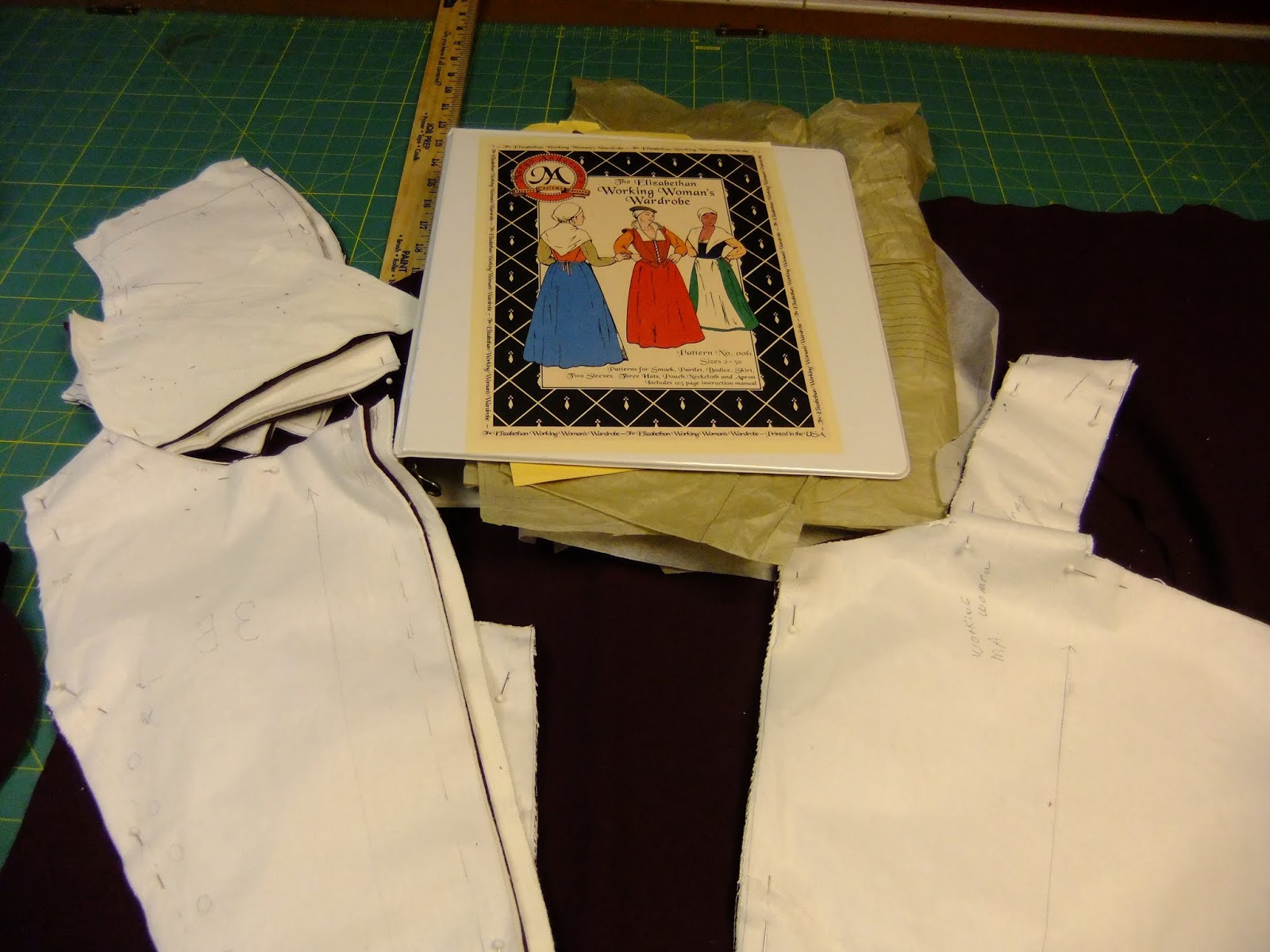
Fitted out an English Loose gown based on a pattern draft from the Tudor Tailors book.  This is a heavy black wool, and is lined in black Satin.

The coat is edged with black velvet ribbon.  The overcast of the ribbon over the sleeve edge was tricky.  I took a lot of small tucks in the ribbon to get it to curve.
The skirt is done in large box pleats.  This is to date one of my favorite items, but alas I can only wear it in Winter.  Last Birka I paired this with a Velvet skirt with Bodice that had a forepart of the figured velvet.  Looks really nice.  Entered it into the Birka fashion show.  Didn't win, but Axel did with his outstanding men's English doublet and breeches he made.  No pictures. :)  

English Jacket


I drafted up, and constructed and English short jacket using some left over gold Linen I had.  The biggest problem I had was fitting over the bust line.  Clothing of this period does not use darts, so shaping when cutting is important.
I am not one to make something only from muslin, then discard it.  If I am going to make it, I will wear it.  I feel I am a good enough seamstress to do this.
Update:  I have taken the front seam apart and cut the bust line down, so there is not so much of a "pump" in the from.
Wearing the Jacket with bum roll.  

These shoot were taken during fitting of second Linen Jacket.  The back is too long, which is causing it to buckle.  The front is held together with safety pins, later I will install hooks and eyes.
Third Jacket.  This is a low neck Jacket. 


New Wardrobe Fall of 2014/2015


After several years wearing OK garb I worked towards making a more authentic Wardrobe.  I will concentrate on a 1500's English persona.  I will continue to refine this into a Lady from 1571.

I used as my base two pattern sources.  Ended up making, in Linen  4 Kirtles:  Blue, green, gold and red.  And two Bodices with Skirts:  Purple Bodice w/skirt,  Black Bodice w/Skirt, and 1 Tan skirt.  Also adjusted what was once a poorly made Kirtle into just a Red Skirt.  I salvaged an older Red Skirts I had made out of a stiff Cotton Broadcloth.  I use this as the underskirt for structure, also it is red (for my health, of course).  It has a modern Zipper (old Ren faire outfit) but no one sees it.  
 Added partlets and wired coifs from the Tudor Tailors. This is a blue wool Kirtle, with lots of skirt.  I wear this often when being a Merchant.  This partlet is black wool.  Made several styles of white linen partlets.  Also need lots of new Linen Chemises to wear under.
All told I made over 20 new pieces of clothing for my wardrobe.
Update:  This was several years ago.  Since then I have lost over 35 pounds.  As a result most everything is too large.  I tried taking in, but outside of deconstructing and reconstructing, nothing fits.  So I plan on giving away or selling, or Gold Keying most of these pieces, and going on another sewing spree.  Now to see when I will stop loosing weight.  Good thing I love to sew.

Tuesday, August 14, 2018

Black Velvet outfit - Maunche


The panels of blackwork above are for sleeves to be added to a partlet with blackwork collar I have.  I have taken these panels with me everywhere to work on them.  The most exotic spot was on a two Masted Schooner I sailed on off the coast of Turkey for a week.  The boat took us out to Malta, a wonderful spot where the Crusader stopped on their way to the Holyland.  The old fort and Halls of the different Knights, with their Heraldry are still there.  
Of course, once I had attached the sleeves, I needed an outfit to wear it with, soooooo


Black velvet Bodice based on pattern from Margo Anderson's Historical Patterns.  Bodice is closed in the front by numerous hooks and eyes.  Underskirt has a fore skirt of the Deco Fabric previously seen. which looks like stamped velvet.  Overskirt and Bodice is out of Rayon Velvet.  Sewing on that stuff is like working on moving water.  You have to use lots of pins.  This outfit is loosely based on a painting of Lady Mary Grey.  Someday I may add strips of Blackwork to the Partlet itself, to complete the look.

I finished this outfit just in time.  Unbeknown to me I was called up in court at Fall Coronation (2014) and awarded my Maunche. This is an award for excellence in the Arts and Sciences given by the East Kingdom, Society for Creative Anachronism (SCA).  This scroll was made by Baroness Nest Verch Tangwistle, and is entirely embroidered.  WOW.  


Monday, August 13, 2018

St. Eligius 11/2017 and the gloves

I entered my gloves to the St. Eligius A&S competition.  This event every year showcase some of the best A&S items prior to the K&Q A&S in February.  I usually enter each year in the experienced competitor level. One of the differences in this competition as to others, is we are the judges.  Instead of having a "group" of judges chosen to judge you, we get together with the others competitors in our level and judge each other.   I enjoy doing this.  I spend the day explaining what I am doing, how I did it, etc.  This year I was chosen by my fellow competitors as the best, or I won.  It is humbling.

The photo above was captured as I was explaining my gloves to this lovely Lady.  She so enjoyed my explanation, asked great questions.  As I finished she apologized that she had to leave to go to a meeting.  Turns out she was the Queen of the East.  I laughed with her.  And I apologized that I didn't know her as I don't pay much attention to that side of the Society.  I'm aware of it, but not involved with it.  She was actually delighted that I didn't know, and just treated her like I do anyone who stops and wants to learn about what I do, and not pander to her.  Lovely experience.

Last pair for now


One last pair for now.  These are made out of soft white deer skin, with brown faux fur cuffs.   This is the thickest leather I have used and I needed to be very careful pushing the needle thru.  I was not totally happy with my last pair of Elizabethan glove.  The front of the gloves the end of the V's on the front were not even,  Did it matter, maybe not,  but this pair (look at right hand) are nice and even across.  I notice.  They are not practical as the fingers are very long, and they are white, but look elegant.  


Elizabethan gloves

Elizabethan I(E1) was known to have very long fingers.  She inherited them from her mother Anne Boleyn.  As a result, most wealthy people of this period are painted holding gloves which show very long fingers to emulate their Queen.  These are not practical gloves, but indicate the required look of conspicuous consumption.
I wanted to make my gloves following the style of glove that belonged to E1 in the V&A book.  But at the same time I wished to match the embroidery to use with a Jacket and Coif I am making instead of using the blackwork pattern extracted from the gloves.  Also the gloves in the V&A are made of linen.  This is unusual as linen gloves are not strong, and mostly used as an inner glove when wearing leather gloves.  But this pair is beautifully embroidered, and show repairs made to them, so may have been more of a summer pair of gloves worn often by E1.  I decided to make my gloves from white leather.  They will be stronger.
First was figuring out the cuff embroidery.  The pattern I used from the Coif, the design was too large for the cuff.  It took several drafts to reduce pattern to a size I felt looked proportionate.  I started stitching the pattern, but the scale to the linen was off.  I had to go to a very fine linen (40ct New Castle linen).  I also need to reduce the size of the paillettes.  Ended up using #17.  These are so fine that to thread the center hole to stitch them down I need to use a very long tiny beading needle.
I finished the cuff off with silver thread using the Elizabethan Ladder braid stitch.  The corners have pearls.  This took several months to complete.  
I debated over a button hole edging or straight stem stitch edging to the silver thread.  Preferred the Stem stitch,  so Yup, I reversed stitch the button hole (pulled it out) and added the stem stitch.  I earned my next level of Crazy Embroiderer.  

The white leather I am using is a heavier suede, split pig hide, then used in my previous gloves.  When stitching on leather you must be careful.  Once you make a hole with the needle, you own the hole.  I was also using the V gusset, or fork, between the fingers, with Querks.  I did not photo these.  The V fork restricts the movement of the fingers to pull apart.  The small querk (small triangle gusset) at the base of the finger allows this movement.  The front of the V goes down the front of the hand adding to the long finger look.

Sewed the cuff, which had already been attached to a lining with buckram. To do this you have to whip stitch the cuff (front and back) to the leather.  
Once the cuff is attached you can then finish off the fingers.  I had attached the thumb earlier.